The shades between grace and grotesque

At a very young age an unknown Indian aunty told my mom that I should start applying gram flour and turmeric daily. She said that’s what made Aishwarya Rai Bachchan fair and pretty. My ten-year-old mind couldn’t understand what was the connection between fairness and being beautiful then, but I do now.

Colorism, a term first coined in the 1983 by Alicia walker, is the prejudicial or preferential treatment of same-race people based solely on their color.

Why would a race of individuals be prejudiced against their own, over something as trivial as having lesser or greater amounts of melanin?

Indians, as we know, did not discriminate on the basis of color, we were a combination of different cultures and races. Historically, there has been inclusion in varied skin colors, so it becomes important to understand how and when skin color become an important physical attribute. All Indian colonizers have one thing in common — their skin. Indians have been captured and conquered by white skinned colonies. It started with Aryans- the white skinned colonizers, attacking the dark-skinned Dravidians then followed by The Persians, The Portuguese, The Mughals and then lastly The British. The conflict may have started with its roots in colorism but soon they turned to be more about territory, money and power, rather than race and color. Britishers then claimed to be superior, more intelligent, who were born to rule the inferior, i.e. the dark-skinned Indians.

After being ruled by white colonies for over three hundred fifty years, the common man began associating white colored skin with the ruling class, with power, with desirability, and also ultimately, with beauty. Unknowingly, it became a practice of attaching the greater societal superiority and power to the fairer skin males and females, which in turn dictated and shaped the desire for a westernized concept of beauty with lighter skin — even after so many years of independence.

Class and caste if not directly are still related to color. As we know an upper caste woman or man is more socially acceptable than the lower caste counterpart; however, within the same case, men and women with lighter skin are almost always preferred to those with darker skin. Throughout India, one can find individuals with varied degrees of skin tone in each of the different caste groups. However, skin color is more location specific than caste specific for example : Kashmiris/north Indians are considered fairer to South Indians. Skin color is now also intertwined with financial status and class.

In a series of surveys and interviews conducted by Washington University Global Studies Law Review. , when woman were asked to describe what did they mean while using the adjective ‘pretty’ , approximately 64% women, out of which many were dark toned, used the word “fair” or “light” as the main attributes. It was evident from the study that dark skinned people, both males and females, aspired to have a lighter skin tone than their own color. While the genesis of this prejudice might be colonization, it is now widely fostered by the media. Media portrays beauty to be fair. I grew up watching commercials where dark skin individuals lead a dull, lonely and miserable life UNTIL they found a fairness lotion. India is one of the largest markets for fairness creams. As of 2019 fairness cream market was worth 3000 crore and this is expected to grow to 5000 till 2023. If a cream does not list skin lighting in it, it won’t sell. Fairness is equated to beauty and fairness creams are considered the tool to achieve that.

Even in the film industry, the fair skinned actors are seen playing the lead roles while their dark-skinned colleagues were their sidekicks or antagonists. All of our billboards, advertisements, movies, television are reserved for fair skinned women, so much so that dark skinned roles are charted by them. The media’s obsession with using fair skinned images greatly influences the general population to look like these lighter skinned models, and therefore use every means to “become beautiful” by using these fairness products.

The general population identifies beauty based on the standards set by these media moguls and while media might not be the cause of it ,it is to be blamed for converting colorism into this multimillion monster. The pervasiveness of color discrimination is evident. This implicit biasness is so deeply engraved in our psyche by media images, that it affects children, genders and classes alike.

•A 5-year-old Tamil girl believes that her sister is more beautiful than her because she is fair.

•A 12-year-old preteen using all sorts of filters and editing apps to make herself look fairer.

•An 18-year-old teen is reminded of her dark skin everyday by her bullies as she awaits the day when her mom allows her to use skin lighting treatments.

•A 25-year-old young woman is visiting cosmetic clinics every day for her treatments, because her education is futile if she is dark skinned.

•A 40-year-old woman applying yellow pastes all over her daughter’s face hoping and praying that her skin turns into a lighter shade.

•A 60 year old woman praying for a fair daughter in law because she wants light toned grandchildren.

When I hear these stories, I see myself. We all have been there at some point of time, haven’t we? We live in a generation where beauty standards are so high that it has become nearly impossible for all of us to be comfortable in our own skin.

Our heart knows that Colorism exists, that these stories have been buried deep in this era of ‘fairness’, but our head denies it. It denies it because no one wants to feel insecure, and thus taking the easy way out of the problem, i.e. ignoring it. No one wants to acknowledge the issue, speak about it openly, or accept it publicly. But I hope that as you reach the end of this article, a little part of you wants to listen to your heart and that you have faith that this is nothing but a concept that has been ingrained in the mind of a common man through generations of colonization and deepened through the fair skinned images all around via the growth of media and popular culture.

So here I say:

Yes I took the brown paper bag test and Yes I failed

Love,

KB

The audacious red

I clench my fists and hold my breath, I’m swept in blood. I don’t say a word for the world claims it’s absurd, I cry drowned in red. 

Menstruation or ‘Periods’. The words we hear for the first and the last time in our biology chapter and the concept we fail to understand for a lifetime. A concept opened for the girls and denormalized for the men of this country. Is the black polythene bag a wake up call?! 

The society has grown and wind of development is flowing over the generation for years. Then why is a regular anatomical process of a body still a taboo? Why are there temples prohibiting women to enter during ‘those’ times and why is that workshop ‘only for girls’? 

All around the world women have been shamed, cloistered, and medicalised for bleeding regularly. The paradox around menstruation has although made it physically better for them in terms of healthcare but we are still too embarrassed to talk, let alone utter out the word PERIOD in public.

As we step into the new realm with higher education standards, it’s time we refine the education to awareness and create an informed dimension. While learning about the Battle of Plassey does hold significance but so is realizing about the bodies and normalising what happens to it. 

A woman’s hormonal reaction should not be the point of hesitation. And as long as we continue to delve into the embarrassment, we’d embark upon a closed mindset in our future. 

What makes us call a girl, a callgirl?


The auspicious city of Benaras is revered to be a pilgrimage in India. Tourists from all over the world come to this fabled city to experience the tranquility and beauty of this small town of U.P., but this pure flame has a dark vapor too. It is a well (un)known fact that if a girl below the age of six is lost, an FIR is not filed with the police. The parents are relieved of the pressures of having a girl child, an irony here where they pray to a goddess for taking away one. This little girl who finds herself to be lost sees a parallel world. She was always fascinated to watch her mother do ‘solah shringara’ i.e 16 ways a married woman gets ready to express her beauty like wearing lipstick , kajal , etc. She secretly wanted to beautify her without getting married. And she did get the grim opportunity to do that but at what cost? This meek girl, finds herself to be followed by a van. The van stops in front of her, showing two tall men ready to grab her by her shoulders. She wakes up, in an unknown environment and hears an old lady say “the men would be happy to have a young woman all by themselves” with chuckles all around. The next thing she knows is that she is dragged to a room full of older looking girls who made her feel somewhat uncomfortable. The kidnapper said,” they are only four five years older to you” the girl fell in silence because all of them looked above the age of 20. One of them reaches out for her hand and tells her that they all are sisters, unless of course one steals another’s client. All the girls start laughing except this new member, another girl tries to pacify her by telling her the benefits of this life like wearing makeup, getting waxed wearing pretty saris, she then nudges and exclaims, “isn’t it every girls dream since childhood to dress up?” oh dressing up but at this cost? A man reaches out to her to get her ‘ready’. While she was settling and adjusting to this new environment, a car pulls up and a girl comes out with tears trickling down her eyes and blood staining her clothes. She runs towards the bathroom and tries to wash off the stinging memories still fresh in her mind. She comes out, numb and asks the lady in charge to take off her chest and her private part. Everyone present in the room stood dumbfounded, she continued and pointed towards her bruised parts and said that the client treated these two parts as if they weren’t attached to a human being. Everyone cries hysterically whilst the main lady provides this girl with some drugs to ease her pain. These little girls lead a life too painful to describe and they do substance abuse to deal with the physical and mental abuse being done to them daily.
When a girl talks about her sexuality, dresses up in a certain way, dances in a certain way,
Does that make her a ‘slut’ or a human being listening to her heart?
Before we label a girl a ‘slut’ do we visualize a grim, abominable career or just a human being owning up her desires?
Do think about it.
Love Prakriti.

LET THE END BE THE BEGINNING.

By- Shiuli Sural.

Is our world crumbling inside four walls ?
The walls of yesterday, today, tomorrow and history…
Has a month, a week or even a day felt this long ?
Like the uncertain chaos of a mystery.

Nothing to do…
Endless days and endless nights.
Eat, sleep, Netflix, repeat
We breathe in silence and talk in virtual spaces
…is that gloom descending on people’s faces ?

Inside our cosy nests we all complain
Still learning to live life in restraint
In detached, distracted, disjointed times…
Man and his machines we cannot hear
Has the world ever come upon a stiller day ?
Has the world ever seen darker times ?

Asked a brown street dog to a black gully cat,
“Why is everyone at home ?
From the cobbler’s son Raju
To the wealthy Kumar’s brat ?”
“Don’t you know,” quipped the cat
“Because of a disease they’re all dead scared,
It makes them fall sick and even some lives might not be spared”.

And foolish man, when his destiny was high,
cut down trees and soared into the sky.
Dangerous, meaningless and heartless.
Never cared about the wilderness.
No, he did not learn in all these years,
That the fate of all beings is the same, none is spared melancholy and fears.

We are all wind among the wind that blows,
Tiny droplets of the rivers that flow,
Those rivers that will one day meet the sea,
In whose infinite depths we shall all be.

So when the smoke clears and normalcy is back,
Let’s rebuild life on the moral track

Remember that life is sweeter
Than gold coins to spend
Nothing is greener than green grass to tend

When the ashes become cool,
And the children are back at school,
Don’t forget those who risked their lives
The frontline warriors, our heroes, our knights
Be kind to all, keep them in your prayers.

Soon we shall all heal,
And so will our Earth.
One fine day in the silence of the dawn,
We will all rise together,
To see the sun’s rebirth.

HOPE

“There was never a night or a problem that could defeat sunrise or hope.” 

Rightly exclaimed that no problem can break the pillar of hope and no shadow can overdo the sunshine. But when we open our eyes to fiddle with this big global scenario, do we see hope? 

The fact that people have started losing ‘hope’ is the basis of the bigger problems. Although the word appears to be small, sure it is big enough to subdue the issues encumbering us. 

The word ‘hope’ is the essence of what happens to a human figure. It is essentially the basis of life. The art of living is a solid basis of the word ‘hope’ that motivates a person to rise like a phoenix and shine like a star. 

But how far is this true? What makes the exclamation that people have started losing hope? Pickup any statistical data analysis and see the figures that analyse the word ‘hope.’ The increase in the rate of suicides tells us that people have lost hope and have forgotten the flavours of life.

The year 1945, witnessed hardcore nuclear bomb attack that slaughtered the lives of innocent humans. But did they lose hope? The art of living sabotaged their problem of mental and physical discomforts and we saw them rising like a phoenix out of the hole full of ashes. 

When we see these stark problems encumbering the world, we appreciate the masses coming out of it. But when we are ourselves affected by small pity problem we lose HOPE.

Cases of peer pressure tell us that there are thousands of young teenagers who strike a knife or hang themselves due to the peer pressure that they couldn’t handle. Subsequently, they lose hope and they quit. 

Unemployment, poverty, hunger strikes etc highlight the fatality of humans and how their brains cannot captivate this pressure. This is the problem that is slowly circling the society. No problem should overpower our mind and no problem is so big that it costs us our life.

With the advent of technology, we have surely advanced ourselves to a great bar, and yet we have got under the mark with the way we live our lives. The essential lifestyle of a human, crying over pity problems, breaking over small things can not only prove fatal for the community but the society as a whole.

Take me to the place full of predicaments, and I won’t grumble because I’m the diamond that shines bright when rubbed with the hardest stone. I won’t look back, I won’t lose hope, I’m the man who rises and falls but one that never loses hope

The stigma is you

“I have depression “


“Don’t worry you will just snap out of it”


“Oh yeah . why didn’t I think of”


I hear and use the word stigma every day and every time I do, I twinge a bit. It just doesn’t feel right.


1 in 4 people suffer from mental illness at some point in their lives . So if you’re sitting in a room count yourself, the person sitting to the right, the person sitting to the left and the person sitting behind or in front of you ; that makes 4 .One of you have some mental illness. It’s that common.


Now think how many of you suffer from mental illness or know someone who does.


If you do the math you will know that all of us should know someone suffering from some mental illness and the fact that many of us may not reflects the stigma.


When we talk about stigma pertaining mental health. We’re saying that people will judge us, have preconceived notions of us or stereotype us due to our mental illness. Like assuming that everyone with eating disorders will be pencil-thin or saying that ‘they just need to eat’. Would ever tell someone on a wheelchair that they just need to get up and walk?


No right.


Mental illness should be viewed the same way as physical illnesses. We shouldn’t view them as less important, mental health departments shouldn’t have less funding and we certainly shouldn’t view it as a weakness or vulnerability.


We take care for those with a physical illness in ways that we wouldn’t even think to do for a person with a mental illness. We help the person receive medical treatment, we take care of them, and above all, we treat their illness with the respect, seriousness, and legitimacy that it deserves. Why then do we not give the same level of care to those with mental illness?


3 out of 4 people who suffer from mental illness report feeling stigmatized. Many times patients are told that there is no such thing as mental illness or that ‘it is all in the head and they are viewed as lazy, weak, demotivated, violent, aggressive and incompetent. The prejudice and discrimination of mental illness is as impairing as the illness itself. It also affects the beliefs of those closest to the individual and results in lack or absence of social support.


Media fuels these beliefs. Most criminals committing crimes are shown to be suffering from mental illness and well it is true that many criminals have mental illnesses, it doesn’t necessarily mean that every individual with mental health is dangerous and unpredictable. In reality people with mental illness are more likely to be victims than perpetrators of crime. It tends to focus on the individual rather than the illness. Psychological disorders are highly generalized like most schizophrenic people are considered violent or depression is always shown to be suicidal and the only way out is by finding love.


Mental illnesses are also linked with a lot of myths which prevent us from understanding it and are most often the reason why people drop out or seek no medical help at all. Myths are deterrent to seeking treatment. Most mental illnesses are treatable and professional help can significantly improve their quality of life and thus it becomes all the more important to destigmatize it.

Although I feel thrilled to see the progress we have made so far, I am also reminded of how much more progress we need to make.


We need to begin by understanding that mental illness is not a choice. A huge misconception is that its perceived to be under the individuals control. We need to start by understanding mental illness for what it is – a medical condition that can be treated. If we see someone around us faint or pass out rush to help but we don’t do this when we see someone is emotionally distressed , and that’s exactly what we need to do , we need to be involved , show our concern and make it our business.
We need to know more, read more, listen more and talk more. We need to have honest conversations where we focus on facts even when those facts are unflattering. Most importantly we need to be kind to people on a daily basis, show compassion and empathy


The truth is there is no hope without action. So while science and medicine continues to pursue the causes and cure of mental health, you pledge to find the heart and muster the will to reach out and to use your voice to end the stigma.

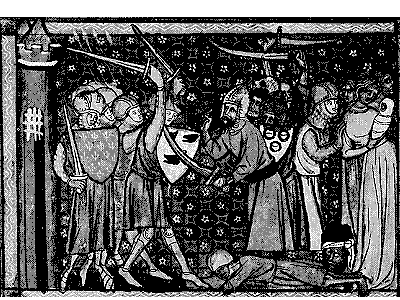
THE CRUSADES: AN AGONY? (PART-2)

The Crusades: 5 Lesser-Known Facts - HistoryExtra

The crusaders’ main aim even after countless failures and internal trifles was Jerusalem. The demands of the successive popes was also limited to the acquisition of the sacred land. Four more crusades were held- they came with their own set of obstacles given the differences among the approach towards each party’s goals. Theoretically we have had eight crusades in total but it is well understood that the reliance on the given evidence shouldn’t always triumph. To comprehend well the intricacies involved in such complex geopolitical scenarios especially of the ancient times, one must view situations with a meticulous eye.

Golgotha Crucifix, Jerusalem

The Embellishment of Political Stunts.

The rivalries in the thirteenth century and the ones we have now, have one thread in common and sadly that is the religious powers vested upon most of the countries’ leaderships. Whether it was the Byzantine empire, the Christendom or the Middle Eastern rulers back then, those at the top of their respective orders flourished whereas their misdemeanours caused havocs for the local populace and the minorities and if we try to scratch out today’s political policies we find it somewhat parallel to what we had decades back, if not same then the deep rooted rivalries still persist very evidently, otherwise we’d be living in an outright utopian state with absolutely no written constitutions and established systematic procedures, right? To digress, not that the former two have served their purpose whole heartedly.

The Siege of Damietta, 1218-19 CE

The beginning of the fifth crusade was based on the crusaders’ one and only agenda as stated before, although this time the shift towards the usual practice was massive and involved a different set of tactics and manoeuvres. The enemy through which they had to cross to achieve their main goal had incompatible and mismatched views on striking a battle with the crusaders, they were the Egyptians and Syrians with the further support of middle easterners. The Pope’s call out to regain control motivated the mob and they were ready to fight again but alas, the fifth crusade rendered futile for the crusaders.

From the sixth crusade onwards, we experienced spellbinding experiences in the name of a new war to be held. A new leader, contentious familial alliances, snobbish theocrats and so called peaceful negotiations were only another figments in the newly designed atmosphere of hostility. This story yet again comes with fascinating revelations to be viewed with both- an analytical interpretation and an off-centre curiosity. After Fredrick II was made the Holy Roman emperor, his dedication and will to conduct peaceful negotiations with the respective enemy- Al kamil won the crusaders their ever lasting demand for the recapitulation of Jerusalem. But for how long did the Hoy land remain in the hands of the crusader army and in the favour of the pope? Did the emperor’s resilience to avoid a war by all means and settling for their empire’s ambitions prove worthy?

The Era of Decadence.

The Battle of Al Mansourah and the Seventh Crusade, 1251 - Warfare ...

Considering there was a seventh crusade after the fallout of the sixth, Jerusalem had slipped out of the hands of the crusaders in no time. This gave them the determination to conduct another war. Although, was the perseverance meritorious or ethically viable? Knowing they had failed six wars because of inexperienced militaries, insufficient resources and inefficient cavalries, the tenacity hadn’t diminished.

Why was the crusader’s control over Jerusalem so important that they were not ready to give up the persistence? What difference had they made by initiating each war and at the end achieving zilch? Why did the crusaders’ wanted to prove their supremacy still, knowing it would come at a bulky price?

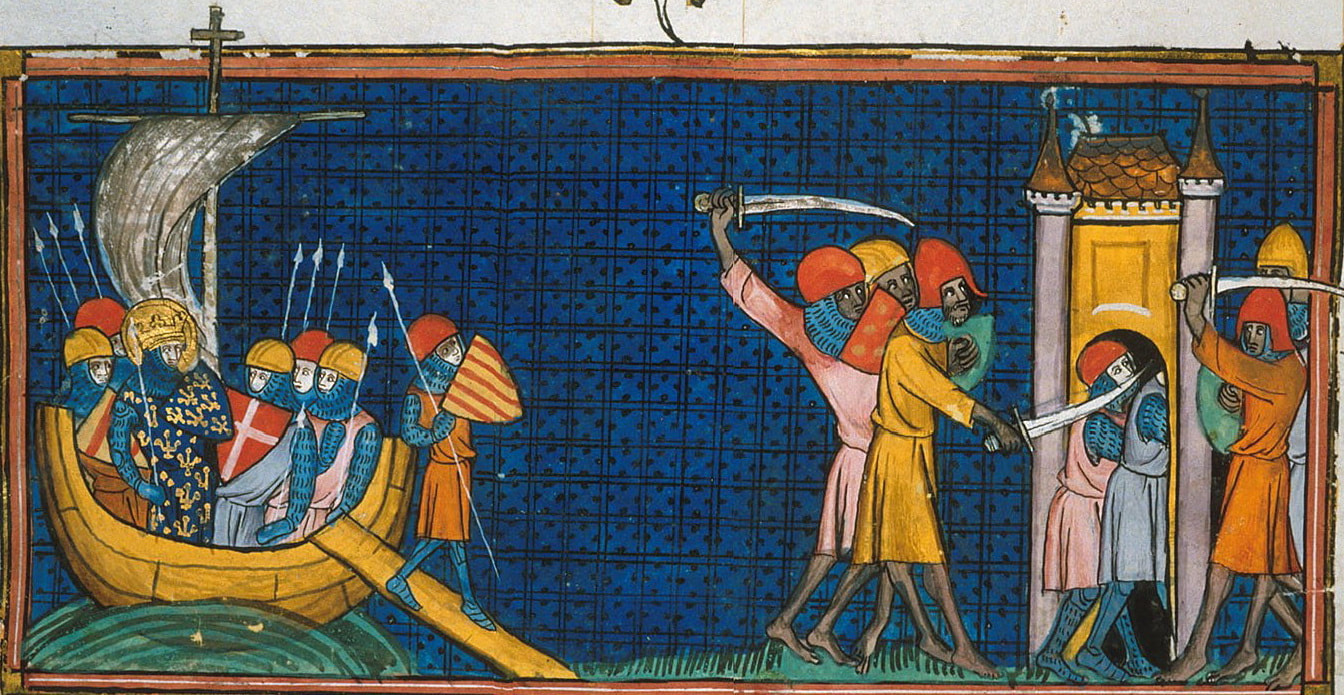
Both, the seventh and eighth crusades were dominated by the French, undoubtedly with the support and religious backing of the pope. The seventh crusade was the first crusade led by Louis XI, who met a disastrous end after his battle of Mansourah and could not succeed in reconquering Jerusalem and the Levant states by invading Egypt and defeating the Muslims. He was determined on achieving his goal so much so that even after a hefty treason he led the eighth crusade, with the same agenda and a similar planning. Only now the situation changed, the enemies diversified. The mongols who were involved in the 7th crusade played a major role in the 8th crusade against the Muslims and Mamluks. Did these ducks and drakes between powerful men give more significance (for the Christians) to the very popular phrase- ‘the enemy of my enemy is my friend’? Yes, it did, later as the French brought the mongols in their ambit eventually.

File:LouisIX Eighth Crusade..jpg - Wikimedia Commons

The 8th crusade was another failed attempt by Louis XI to destroy the Muslim held cities in Egypt. The only difference here was that now instead of Damietta they entered Egypt through Tunis. Being the last of the crusades officially, its failure was due to the death of Louis’s death due to dysentery. However, was it really the death of Louis or the internalised politics between the trinity that created a ‘royal mess’ and the death has been revealed as an excuse like always?

The last crusade was abandoned naturally but Charles of Anjou was keen on continuing with the withdrawal. How sophisticated and subtle of the French back then who created undaunted and unwanted tensions between issues that had a possibility of being dealt with tranquility.

Irony turned to Blasphemy?

The Eighth Crusade

I have a hard time in believing that these wars were held in the name of the Pope, a religious head, someone who is and was revered amongst the knights and leaders, someone who revers Christianity as the zenith of humanity, forgot his moral structures and resorted back to violent means to achieve the goal, the goal if we scrap out religious means from it only involved the reacquisition of a prestigious land and adjoining territories. Is that how Christ would have wanted a sin to be dealt with?, with loss of lives, failed political adventures, materialistic preferences? The fact that these were religious wars, I would like to place a great deal of attention towards religion- what is it supposed to mean and how people perceive it according to their suitable needs and wants. God would never want laypersons turned to knights to be recruited from across the world to fight in the name of religion- a concept that revolves around God itself. God, apparently never asked for such long chains of fights for land disputes. I cannot explicitly tell what God wants or wanted, agnosticism is what I believe in but If God ever existed, I am certain that that Almighty would have only wanted peace and humanity to prevail as presented in all Holy books principally. And the crusades, very evidently do not provide a glimpse of peace being conquered, for simple reasons- the ancestors gave religion an importance which our hearts can never fathom.

Eighth Crusade - History Crunch - History Articles, Summaries ...

SOURCES- https://www.ancient.eu/Eighth_Crusade/ https://www.ancient.eu/Seventh_Crusade/ https://www.ancient.eu/Sixth_Crusade/ https://www.ancient.eu/Fifth_Crusade/

Scars To Your Beautiful

Acid attack is not something unheard of in India. The nation has been shocked to the core again and again hearing horrific stories of people who’ve survived acid attacks. The Indian Penal Code was modified in 2013 for the first time to add regulations tailored to acid attacks. But the sad truth remains that we have not done enough, even if we’ve done something.
My heart fills with grief thinking about the plight of the people who’ve gone through this experience, it drains you emotionally and makes you give up on life.
Acid attack is the worst thing one human could inflict on another, the worst thing one can ever do in the name of anger. It leads to complete debilitation, loss of income and most of all, lack of self esteem.
Even if we overlook all this, how can we ignore the fact that the one who’s going through it has probably started to hate herself/himself?
I’m sorry but this is the sad truth, the sad reality of India.
What is it that makes one throw acid on the victim?
85% of victims are women, so acid attack can overwhelmingly be classified as gender violence. For the 15% male victims, the primary cause of attack is property dispute.
What factors allow such attacks?
Un-counseled anger or agitation, frustration is one of the main reasons why women become the victim. Sociopathic traits and societal chauvinism also play a significant role.
The best way to end acid violence is to prevent it from happening in the first place by addressing its root causes. Education is critical in prevention of acid attacks and other forms of violence against women and girls.
Prevention should start in early life, by educating and working with young boys and girls and promoting respectful relationships and gender equality.
On an ending note, women are not victims, they are survivors. You can change their faces, not their dreams. They have imperishable souls.

PERIOD POVERTY IS REAL

By Shiuli Sural

New Zealand is all over the news, be it their responsible handling of the COVID-19 virus, or PM Jacinda Ardern’s boldly brilliant initiatives. They are reaching new heights in healthcare, and the whole world is praising Arden’s (who became the youngest female head of govt in the world at age 37) governance.

Recently, the country added another feather in its already brimming cap- Schoolgirls in New Zealand will now receive free sanitary products as part of their government’s effort to end period poverty.

In its bid to support young people to continue learning at school, the government will be paying for necessary items such as sanitary pads and tampons in schools across the country.

Period poverty is a very real issue, and it mostly affects women and girls that cannot afford or do not have access to safe and hygienic sanitary products. It is a term used to refer to the lack of awareness and education about menstrual health and lack of access to sanitary products and facilities. The most obvious and prevalent case is of limited access to hygiene products. This leads to prolonged use of the same tampons or pads, which are known to cause various infections and diseases.

According to a One KidsCan survey from 2018 found out that one of three women in New Zealand had to choose between buying food and sanitary products, with some respondents saying that they had to use toilet paper, rags, old clothes, and even diapers when they could not afford tampons or pads.

The government of New Zealand will be investing a whopping $2.6 million in the initiative.

The PM announced – “Our plan to halve child poverty in 10 years is making a difference but there is more to do, and with families hit hard by the COVID-19 global pandemic it’s important to increase that support in the areas it can make an immediate difference. 95,000 nine- to 18-year-olds may stay at home during their periods due to not being able to afford period products. By making them freely available, we support these young people to continue learning at school,” Ardern said.

New Zealand’s Minister for Women, Julie Anne Genter, also added: “Menstruation is a fact of life for half the population and access to these products is a necessity, not a luxury.”

This initiative is going to be introduced during term three at 15 schools in the region of Waikato on the North Island. The roll-out will begin at 15 Waikato schools and will then be expanded to all state and state-integrated schools on an opt-in basis in 2021.

While Twitter is rightly flooding with appreciation, praising this move by the NZ govt, let’s take a look closer home at India’s struggle with ensuring menstrual hygiene.

INDIA’S TRYST WITH MENSTRUAL HYGIENE
New Zealand’s brave move makes us realize how little has been done for menstrual hygiene in India.
The Indian government had levied a 12% tax on Sanitary pads under India’s Goods and Services Tax (GST) that was launched in July 2017.

This unfair and irresponsible decision triggered protests, petitions and court cases that questioned why the government taxed pads as a luxury rather than as an essential item.

It took a harsh, long battle of endless protests, surveys and online petitions to get sanitary pads tax free. Finally, on June 2018 pads were declared tax free of the 12 percent tax under GST.
However, this battle is far from over. Materials and inputs like polythene film and glue used to produce sanitary napkins continue to attract GST rate of 18% and inputs like release paper, wood pulp attract GST at the rate of 12%.
This means that ultimately the price of sanitary products has risen (tax or no tax), making it even more difficult for people from the lower end of the economy to purchase these products. Not surprisingly, India’s global rank in healthcare is a dissatisfying 154.

According to the Family Health Survey 2018, of the approximately 336 million menstruating women in India about 121 million (roughly 42 percent) women use sanitary napkins, which are both locally and/or commercially produced.

If there is an impediment in the manufacture of these products, the hygiene conditions will deteriorate and women will be more prone to menstrual infections and diseases like cervical cancer, Reproductive Tract Infections, Hepatitis B infection, various types of yeast infections and Urinary Tract Infection.

Women and trans men from rural and marginalised areas will be even worse off as they already have very less access to healthcare and hygiene products.

The cultural and social shame attached to menstruation belittles women even further. The lack of hygiene, lack of education about hygiene and lack of supply of hygiene products has affected millions of women and trans-men across countries, timezones and continents. In India, despite the introduction of the Beti Bachao Beti Padhao Abhiyaan, the disturbing reality of rural women speaks volumes for itself.

The current world situation has rendered them even more helpless. In the nationwide lockdown due to the COVID-19 virus, innumerable women in rural areas do not have rudimentary access to sanitary napkins, tampons, clean water and several other hygiene products. Some of these have been demarcated by the Indian Government as non-essential goods, causing supply issues across the country in the dark times of a global pandemic.

Big Basket, Amazon and Grofers are finding it increasingly difficult to get supplies of these products in this situation. This sad state of affairs hits women and trans-men from lower castes, low economic backgrounds and poor classes the most.

Out of all the states, the Telangana and Karnataka government have enlisted items such as sanitary napkins, soap and other hygienic products as essential goods.

This reality demands quick, lasting and effective solutions. The citizens and government both have important roles to play in this. As citizens, and as human beings, raise awareness about period poverty being real.
As for the government, the first step is to reduce and remove the institutionalized misogyny from within the government itself.
 There needs to be a revision of the list of “essential goods” which needs to include all the hygiene products like tampons, sanitary pads and even medecines related to menstruation.
The Ministry of Consumer Affairs, the Ministry of Health, Minsitry of Women and Child Development and the Prime Minister’s office need to take steps and ensure uninterrupted supply of hygiene products in affected areas.

The hard reality for almost 58% women in India is that they have to go through their everyday lives without these essential products, something we cannot even fathom sitting in our homes in the city. So, speak up and spread the word. Period Poverty is real. And it needs to be tackled.

Things Unsaid

To the one who never leaves an opportunity to smother me with love and kindness.
My hands are shaking a bit, I’m feeling a little perplexed. I remember the time you held my hand when I didn’t want to leave mom and go to school. My feet were jammed on the ground, my face on the brink of crying.
Today, I feel grateful to you for pushing me to take the first step.
I was scared of the dark. You never painted galaxies on the back of my palm to make me feel less insecure. You taught me that sometimes, to come out of a dark place, you need to be shown excess light.
Thank you for being the light, for being my saviour.
I don’t say this often but it really did mean everything to me when the poems I initially wrote, which apparently had no standard, no class were still rated with 7 stars by you.
Maybe, that is what helped me fall more in love with writing.
I’m sure that you do notice, you’re not an unsung hero for me. I may not tell you out loud how much I respect you for being the dad you are, but I like to show it to you in subtle, little ways.
I’ve never told you this. At times, I’ve felt exasperated to the level that I wanted to give up. Reason?
I had an argument with you. I will never know what being my dad feels like, if the experience is overwhelming or makes you proud.
Your words of advice are ethereal phrases which help me when I am at my lowest.
I really have not known anyone like you, someone who can make me smile when I might want to cry for an hour straight. You’re a person with infectious energy and happy little giggles. You’re the one who is there in all my favourite memories.
My life exists within the realms of the ceaseless love you shower me with.
I’m just listing down the things I have never told you, the things unsaid, the things beautiful.
The things which I can never justify through word of mouth.

Design a site like this with WordPress.com
Get started